What does a DevOps Engineer do daily, and how can I introduce myself as a DevOps engineer?
A DevOps Engineer plays a pivotal role in bridging the gap between software development and IT operations, ensuring seamless collaboration and automation across the software delivery lifecycle. Their daily tasks revolve around improving efficiency, maintaining infrastructure, and enabling continuous integration and deployment (CI/CD) for faster and more reliable software delivery.
Daily Activities of a DevOps Engineer
- Collaborating with Teams
- Attend daily stand-up meetings with developers, QA, and operations teams to align on tasks, goals, and challenges.
- Provide solutions for deployment issues and support team members in resolving environment-related problems.
- Building and Managing CI/CD Pipelines
- Design, implement, and maintain automated pipelines for continuous integration and deployment using tools like Jenkins, GitLab CI/CD, or GitHub Actions.
- Ensure smooth code deployment to staging, testing, and production environments.
- Infrastructure Management
- Manage cloud-based infrastructure on platforms like AWS, Azure, or Google Cloud using Infrastructure as Code (IaC) tools such as Terraform or CloudFormation.
- Scale resources to handle system demands and optimize costs.
- Monitoring and Incident Response
- Monitor application performance and system health using tools like Prometheus, Grafana, or CloudWatch.
- Respond to alerts, troubleshoot system failures, and implement solutions to prevent future incidents.
- Automating Processes
- Automate repetitive tasks like server provisioning, configuration management, and deployment using tools like Ansible or Chef.
- Focus on reducing manual efforts and increasing overall system reliability.
- Enhancing System Security
- Implement secure practices for CI/CD pipelines and cloud infrastructure by managing secrets, enforcing IAM policies, and conducting regular vulnerability scans.
- Stay updated on security best practices to protect applications and infrastructure.
- Documentation and Reporting
- Document infrastructure configurations, CI/CD workflows, and troubleshooting guides for reference and team collaboration.
- Maintain logs and reports on incidents, deployments, and updates.
- Staying Updated
- Research and experiment with new DevOps tools, technologies, and best practices to improve workflows and stay competitive.
Could you give an introduction yourself and your daily activities as a DevOps engineer?
As a DevOps engineer, I bridge the gap between development and operations teams to ensure smooth and efficient software delivery. My role involves automating processes, managing infrastructure, and enhancing collaboration between teams to achieve continuous integration and continuous delivery (CI/CD). I work with various tools and technologies to streamline workflows, improve system reliability, and ensure rapid deployment of applications.
Daily Activities
- Morning Stand-Up Meetings: I start my day with a stand-up meeting to discuss the progress of ongoing projects, address any blockers, and plan the day’s tasks.
- Infrastructure Management: I manage and monitor the infrastructure using tools like AWS, Azure, or Google Cloud Platform. This includes provisioning and configuring servers, managing storage, and ensuring network security.
- CI/CD Pipeline Maintenance: I maintain and optimize CI/CD pipelines using tools like Jenkins, GitLab CI, or CircleCI. This involves automating build, test, and deployment processes to ensure rapid and reliable software delivery.
- Code Reviews and Collaboration: I collaborate with developers to review code changes, provide feedback, and ensure that best practices are followed. This helps in maintaining code quality and reducing deployment issues.
- Monitoring and Logging: I set up and manage monitoring and logging systems using tools like Prometheus, Grafana, and ELK Stack. This helps in identifying and resolving issues proactively, ensuring system reliability.
- Automation and Scripting: I write scripts and automation tools using languages like Python, Bash, or PowerShell to automate repetitive tasks and improve efficiency.
- Security and Compliance: I ensure that the infrastructure and applications comply with security standards and regulations. This involves implementing security best practices, conducting vulnerability assessments, and managing access controls.
- Incident Response: In case of any incidents or outages, I respond promptly to troubleshoot and resolve issues. This involves analyzing logs, identifying root causes, and implementing fixes to prevent future occurrences.
- Documentation and Training: I document processes, configurations, and best practices to ensure knowledge sharing within the team. I also conduct training sessions to help team members understand and adopt new tools and practices.
- Continuous Improvement: I continuously evaluate and adopt new tools, technologies, and methodologies to improve the efficiency and effectiveness of the DevOps processes.
Being a DevOps engineer requires a blend of technical skills, problem-solving abilities, and effective communication. It’s a dynamic and rewarding role that plays a crucial part in the success of software development and delivery.
How to Introduce Yourself as a DevOps Engineer
Introducing yourself as a DevOps engineer can set the tone for your professional interactions and help you establish credibility. Whether you’re meeting new colleagues, attending a job interview, or networking at an industry event, a well-crafted introduction can make a lasting impression. Here’s a guide to help you introduce yourself effectively as a DevOps engineer:
1. Start with a Strong Opening
Begin with a confident and clear statement about who you are and your role. For example: “Hi, I’m [Your Name], a DevOps engineer with [X] years of experience in automating and optimizing software development processes.”
2. Highlight Your Expertise
Briefly mention your key skills and areas of expertise. This helps to establish your credibility and gives the listener an idea of what you bring to the table. For example: “I specialize in continuous integration and continuous delivery (CI/CD), infrastructure as code (IaC), and cloud computing. I’m proficient in tools like Jenkins, Docker, Kubernetes, and AWS.”
3. Mention Your Achievements
Share a few notable achievements or projects you’ve worked on. This demonstrates your capability and experience. For example: “In my previous role at [Company], I led the implementation of a CI/CD pipeline that reduced deployment times by 50%. I also automated the infrastructure provisioning process using Terraform, which improved scalability and reliability.”
4. Express Your Passion
Show your enthusiasm for DevOps and continuous improvement. This helps to convey your commitment and passion for the field. For example: “I’m passionate about leveraging automation and collaboration to streamline development processes and deliver high-quality software. I enjoy staying up-to-date with the latest DevOps trends and technologies.”
5. Conclude with Your Goals
End your introduction by mentioning your professional goals or what you’re looking to achieve in your current role. This gives the listener an idea of your aspirations and how you plan to contribute. For example: “I’m excited to be part of a team that values innovation and continuous improvement. My goal is to help drive the adoption of DevOps practices and contribute to the success of our projects.”
Example Introduction
“Hi, I’m [Your-Name], a DevOps engineer with five years of experience in automating and optimizing software development processes. I specialize in continuous integration and continuous delivery (CI/CD), infrastructure as code (IaC), and cloud computing. I’m proficient in tools like Jenkins, Docker, Kubernetes, and AWS. In my previous role at Tech Solutions, I led the implementation of a CI/CD pipeline that reduced deployment times by 50%. I also automated the infrastructure provisioning process using Terraform, which improved scalability and reliability. I’m passionate about leveraging automation and collaboration to streamline development processes and deliver high-quality software. I enjoy staying up-to-date with the latest DevOps trends and technologies. I’m excited to be part of a team that values innovation and continuous improvement. My goal is to help drive the adoption of DevOps practices and contribute to the success of our projects.”
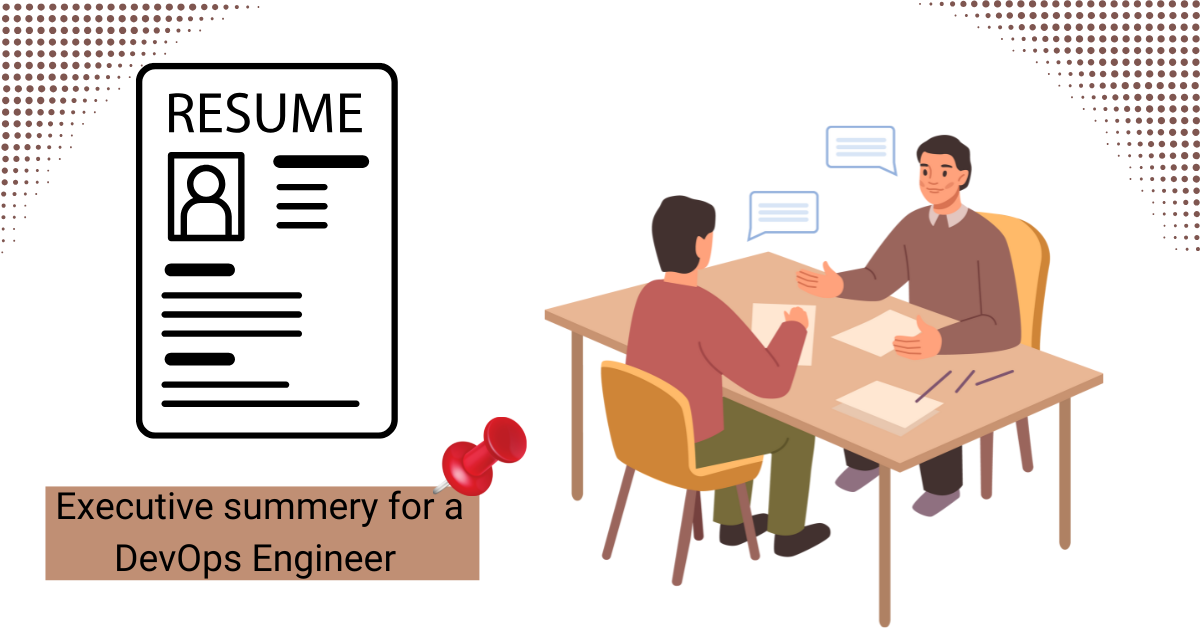
Write a professional executive summary for your resume.
You can use the sample below,
Executive Summary [for a DevOps Engineer with 3 years of experience]
As a DevOps Engineer with three years of experience, I have honed my skills in automating and optimizing software development processes to enhance efficiency and reliability. My expertise lies in continuous integration and continuous delivery (CI/CD), infrastructure as code (IaC), and cloud computing. I have a proven track record of implementing robust CI/CD pipelines, automating infrastructure provisioning, and ensuring seamless deployment of applications.
In my previous roles, I have successfully led projects that reduced deployment times by 50% and improved system scalability and reliability. I am proficient in tools such as Jenkins, Docker, Kubernetes, and AWS, and have experience in scripting with Python and Bash. My strong problem-solving abilities, coupled with effective communication and collaboration skills, enable me to work seamlessly with cross-functional teams to achieve project goals.
I am passionate about leveraging automation and collaboration to streamline development processes and deliver high-quality software. My goal is to continue driving the adoption of DevOps practices, contributing to the success of innovative projects, and fostering a culture of continuous improvement within the organization.
If you are looking for DevOps interview material you may click here

Cybersecurity Architect | Cloud-Native Defense | AI/ML Security | DevSecOps
𝐖𝐢𝐭𝐡 𝟐𝟑+ 𝐲𝐞𝐚𝐫𝐬 𝐨𝐟 𝐞𝐱𝐩𝐞𝐫𝐭𝐢𝐬𝐞 𝐢𝐧 𝐜𝐲𝐛𝐞𝐫𝐬𝐞𝐜𝐮𝐫𝐢𝐭𝐲 𝐚𝐧𝐝 𝐜𝐥𝐨𝐮𝐝-𝐧𝐚𝐭𝐢𝐯𝐞 𝐝𝐞𝐟𝐞𝐧𝐬𝐞, 𝐈 𝐚𝐫𝐜𝐡𝐢𝐭𝐞𝐜𝐭 𝐫𝐞𝐬𝐢𝐥𝐢𝐞𝐧𝐭 𝐝𝐢𝐠𝐢𝐭𝐚𝐥 𝐞𝐜𝐨𝐬𝐲𝐬𝐭𝐞𝐦𝐬 𝐛𝐲 𝐢𝐧𝐭𝐞𝐠𝐫𝐚𝐭𝐢𝐧𝐠 𝐙𝐞𝐫𝐨 𝐓𝐫𝐮𝐬𝐭, 𝐭𝐡𝐫𝐞𝐚𝐭 𝐢𝐧𝐭𝐞𝐥𝐥𝐢𝐠𝐞𝐧𝐜𝐞, 𝐚𝐧𝐝 𝐩𝐫𝐨𝐚𝐜𝐭𝐢𝐯𝐞 𝐫𝐢𝐬𝐤 𝐦𝐢𝐭𝐢𝐠𝐚𝐭𝐢𝐨𝐧 𝐢𝐧𝐭𝐨 𝐞𝐯𝐞𝐫𝐲 𝐥𝐚𝐲𝐞𝐫 𝐨𝐟 𝐢𝐧𝐟𝐫𝐚𝐬𝐭𝐫𝐮𝐜𝐭𝐮𝐫𝐞.
My journey began in network security (firewalls, IDS/IPS) and evolved through Linux/Windows hardening, IAM, and DevSecOps—bridging security with agile development. Today, I specialize in securing multi-cloud (AWS/Azure/GCP) environments.
𝐀𝐬 𝐚 𝐭𝐫𝐮𝐬𝐭𝐞𝐝 𝐚𝐝𝐯𝐢𝐬𝐨𝐫, 𝐈 𝐡𝐞𝐥𝐩 𝐨𝐫𝐠𝐚𝐧𝐢𝐳𝐚𝐭𝐢𝐨𝐧𝐬:
✔️ Align security investments with business objectives (reducing TCO while maximizing cyber ROI).
✔️ Prioritize risks executives care about—translating technical vulnerabilities into financial/operational impact.
✔️ Optimize team workflows by merging DevSecOps agility with governance rigor—no more “security vs. speed” trade-offs.
𝐂𝐨𝐫𝐞 𝐒𝐭𝐫𝐞𝐧𝐠𝐭𝐡𝐬 & 𝐃𝐢𝐟𝐟𝐞𝐫𝐞𝐧𝐭𝐢𝐚𝐭𝐢𝐨𝐧:
𝘌𝘯𝘥-𝘵𝘰-𝘦𝘯𝘥 𝘴𝘦𝘤𝘶𝘳𝘪𝘵𝘺 𝘢𝘳𝘤𝘩𝘪𝘵𝘦𝘤𝘵𝘶𝘳𝘦—𝘧𝘳𝘰𝘮 𝘯𝘦𝘵𝘸𝘰𝘳𝘬 𝘩𝘢𝘳𝘥𝘦𝘯𝘪𝘯𝘨 𝘵𝘰 𝘈𝘐-𝘥𝘳𝘪𝘷𝘦𝘯 𝘵𝘩𝘳𝘦𝘢𝘵 𝘥𝘦𝘵𝘦𝘤𝘵𝘪𝘰𝘯.
𝐌𝐮𝐥𝐭𝐢-𝐂𝐥𝐨𝐮𝐝 𝐒𝐞𝐜𝐮𝐫𝐢𝐭𝐲: Deep expertise in AWS/Azure/GCP security tools (Kubernetes, CSPM, CWPP).
𝐓𝐡𝐫𝐞𝐚𝐭 𝐈𝐧𝐭𝐞𝐥𝐥𝐢𝐠𝐞𝐧𝐜𝐞 & 𝐅𝐨𝐫𝐞𝐧𝐬𝐢𝐜𝐬: Proactive hunting, incident response, and post-breach analysis.
𝐙𝐞𝐫𝐨 𝐓𝐫𝐮𝐬𝐭 & 𝐈𝐀𝐌: Architecting least-privilege access, PKI, and micro-segmentation.
𝐀𝐈/𝐌𝐋 𝐒𝐞𝐜𝐮𝐫𝐢𝐭𝐲: Securing LLMs, MLOps pipelines, and data lakes against adversarial attacks.
𝐑𝐞𝐜𝐞𝐧𝐭 𝐂𝐨𝐧𝐬𝐮𝐥𝐭𝐢𝐧𝐠 𝐏𝐫𝐨𝐣𝐞𝐜𝐭𝐬 – 𝐀𝐠𝐞𝐧𝐭𝐢𝐜 𝐀𝐈 & 𝐀𝐈 𝐒𝐞𝐜𝐮𝐫𝐢𝐭𝐲:
✔️ Led security architecture for a GenAI‑powered Agentic AI system (autonomous task‑planning agents using LangChain & AutoGPT). Designed guardrails against prompt injection, tool‑calling abuse, and data exfiltration via agent‑to‑agent communication. Result: Zero security breaches across 10k+ agentic transactions.
✔️ Advised a fintech firm on AI supply chain security – hardened their LLM fine‑tuning pipeline (Hugging Face + AWS SageMaker) against model poisoning and backdoor attacks. Implemented real‑time anomaly detection for model inputs using statistical outlier scoring.
Let’s connect and discuss the future of secure, intelligent infrastructure.