

How to Prepare for Linux Fresher Interviews in Kolkata?
In the rapidly growing IT industry in Kolkata, Linux skills are in high demand, making it one of the most promising career paths for freshers. As Linux continues to be the backbone of servers, cloud platforms, and DevOps pipelines, mastering it can help you land your dream job. Whether you’re looking for Linux jobs for freshers in Kolkata, preparing for entry-level Linux administrator jobs in Kolkata, or attending walk-in interviews for Linux freshers in Kolkata, this guide will equip you with everything you need to succeed.

Choosing Linux as a career path in Kolkata offers numerous advantages, making it an excellent choice for tech enthusiasts and professionals. Kolkata, known for its vibrant IT sector and growing tech community, provides ample opportunities for Linux professionals. The demand for Linux expertise is on the rise, with many local companies and startups seeking skilled individuals to manage their servers, networks, and cloud infrastructure. Additionally, Kolkata’s affordable living costs and rich cultural heritage make it an attractive destination for tech professionals. By pursuing a career in Linux, you can tap into the city’s expanding job market, benefit from competitive salaries, and contribute to the thriving tech ecosystem. Whether you’re a beginner or an experienced professional, Kolkata offers a supportive environment for career growth in Linux, with numerous training centers, workshops, and networking events to enhance your skills and knowledge.
Why Choose Linux as a Career Path in Kolkata?
Kolkata, known for its growing IT sector, offers several opportunities for freshers to build a career in Linux. Many companies rely on Linux for its stability, security, and scalability. The demand for Linux administrators, DevOps engineers, and system admins is consistently rising.
Key reasons to pursue Linux jobs for freshers in Kolkata:
- High demand for Linux skills in IT and software companies.
- Numerous job opportunities in startups and established firms.
- Competitive salaries for entry-level roles.
- Opportunities to work on cutting-edge technologies like cloud computing and DevOps.
What Are the Requirements for Linux Jobs in Kolkata for Freshers?
For freshers looking to start a career in Linux in Kolkata, there are several key requirements and skills that employers typically look for:
1. Educational Background
- Degree: A bachelor’s degree in Computer Science, Information Technology, or a related field is often preferred.
- Certifications: Certifications such as Red Hat Certified System Administrator (RHCSA) or CompTIA Linux+ can be advantageous.
2. Technical Skills
- Basic Knowledge of Linux: Understanding of Linux operating systems like CentOS, Red Hat, and Ubuntu.
- Command Line Proficiency: Ability to use the Linux command line for various tasks.
- Scripting: Knowledge of scripting languages like Bash, Python, or Perl.
- Networking: Basic understanding of networking concepts and protocols.
- System Administration: Familiarity with system administration tasks such as user management, file permissions, and software installation.
3. Practical Experience
- Internships: Any internship experience related to Linux system administration or support can be beneficial.
- Projects: Hands-on projects or lab work that demonstrate your ability to work with Linux systems.
4. Soft Skills
- Problem-Solving: Ability to troubleshoot and resolve issues efficiently.
- Communication: Good verbal and written communication skills to interact with team members and clients.
- Teamwork: Ability to work collaboratively in a team environment.
5. Job-Specific Requirements
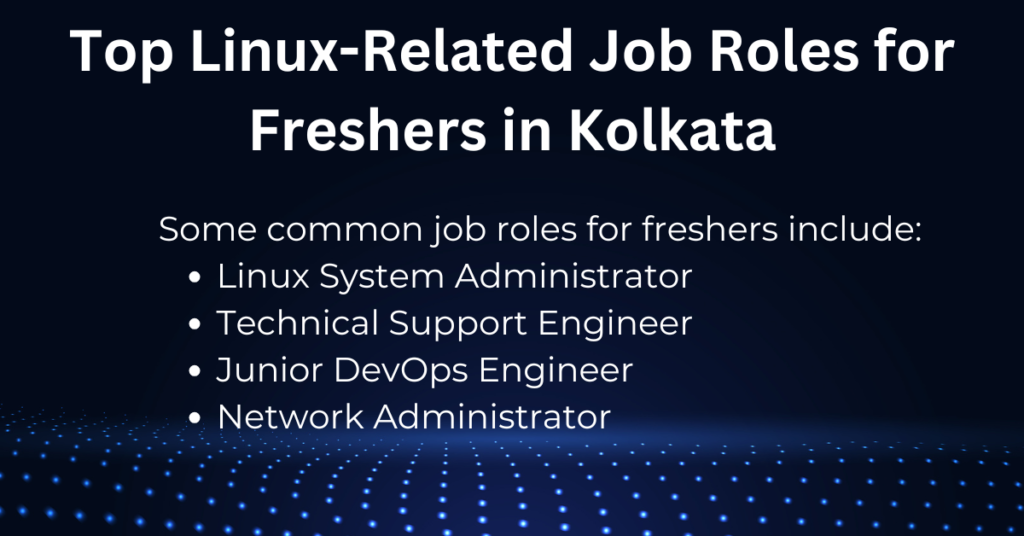
- Roles and Responsibilities: Understanding the specific roles and responsibilities of the job you are applying for, such as Linux System Administrator, Linux Support Engineer, or Linux Developer.
- Company-Specific Requirements: Some companies may have additional requirements, such as knowledge of specific tools or technologies used in their environment.
6. Local Job Market Insights
- Job Portals: Regularly check job portals like for Linux job openings in Kolkata.
- Networking: Attend local tech meetups, workshops, and networking events to connect with potential employers and stay updated on job opportunities.
By meeting these requirements and continuously improving your skills, you can increase your chances of securing a Linux job in Kolkata as a fresher.
How to Start a Career in Linux as a Fresher in Kolkata?
- Enroll in a Linux Training Program: Learn Linux basics and advanced skills from the best institutes for Linux training in Kolkata.
- Earn a Linux Certification: Certifications like RHCSA, RHCE, or Linux+ add credibility to your profile.
- Gain Practical Experience: Practice on virtual machines or contribute to open-source projects.
- Search for Linux Fresher Jobs: Use job portals and attend walk-in interviews for Linux freshers in Kolkata.
Which Linux Certifications Are Needed for Freshers in Kolkata?
- Red Hat Certified System Administrator (RHCSA): Perfect for beginners.
- Linux Professional Institute Certification (LPIC-1): Focuses on basic Linux skills.
- CompTIA Linux+: Covers foundational and advanced Linux topics.
- AWS Certified SysOps Administrator – Associate: Great for cloud-related Linux jobs.
AEM Institute is a reputable center for RHCSA training on RHEL 9. By obtaining these certifications, freshers can enhance their knowledge, demonstrate their skills to potential employers, and increase their chances of securing Linux-related jobs in Kolkata. If you need more details or have any specific questions, feel free to ask!

Expected Linux jobs salary in 2025 for freshers
The salary for freshers in Linux jobs in Kolkata can vary based on the company, role, and the candidate’s skills and certifications. On average, freshers can expect a salary range of ₹18,000 to ₹25,000 per month. Some companies may offer higher salaries depending on the specific requirements and the candidate’s qualifications. For example, roles such as Linux System Administrator, Linux Support Engineer, and Linux System Engineer are common entry-level positions that offer competitive salaries for freshers in the field.

Cybersecurity Architect | Cloud-Native Defense | AI/ML Security | DevSecOps
𝐖𝐢𝐭𝐡 𝟐𝟑+ 𝐲𝐞𝐚𝐫𝐬 𝐨𝐟 𝐞𝐱𝐩𝐞𝐫𝐭𝐢𝐬𝐞 𝐢𝐧 𝐜𝐲𝐛𝐞𝐫𝐬𝐞𝐜𝐮𝐫𝐢𝐭𝐲 𝐚𝐧𝐝 𝐜𝐥𝐨𝐮𝐝-𝐧𝐚𝐭𝐢𝐯𝐞 𝐝𝐞𝐟𝐞𝐧𝐬𝐞, 𝐈 𝐚𝐫𝐜𝐡𝐢𝐭𝐞𝐜𝐭 𝐫𝐞𝐬𝐢𝐥𝐢𝐞𝐧𝐭 𝐝𝐢𝐠𝐢𝐭𝐚𝐥 𝐞𝐜𝐨𝐬𝐲𝐬𝐭𝐞𝐦𝐬 𝐛𝐲 𝐢𝐧𝐭𝐞𝐠𝐫𝐚𝐭𝐢𝐧𝐠 𝐙𝐞𝐫𝐨 𝐓𝐫𝐮𝐬𝐭, 𝐭𝐡𝐫𝐞𝐚𝐭 𝐢𝐧𝐭𝐞𝐥𝐥𝐢𝐠𝐞𝐧𝐜𝐞, 𝐚𝐧𝐝 𝐩𝐫𝐨𝐚𝐜𝐭𝐢𝐯𝐞 𝐫𝐢𝐬𝐤 𝐦𝐢𝐭𝐢𝐠𝐚𝐭𝐢𝐨𝐧 𝐢𝐧𝐭𝐨 𝐞𝐯𝐞𝐫𝐲 𝐥𝐚𝐲𝐞𝐫 𝐨𝐟 𝐢𝐧𝐟𝐫𝐚𝐬𝐭𝐫𝐮𝐜𝐭𝐮𝐫𝐞.
My journey began in network security (firewalls, IDS/IPS) and evolved through Linux/Windows hardening, IAM, and DevSecOps—bridging security with agile development. Today, I specialize in securing multi-cloud (AWS/Azure/GCP) environments.
𝐀𝐬 𝐚 𝐭𝐫𝐮𝐬𝐭𝐞𝐝 𝐚𝐝𝐯𝐢𝐬𝐨𝐫, 𝐈 𝐡𝐞𝐥𝐩 𝐨𝐫𝐠𝐚𝐧𝐢𝐳𝐚𝐭𝐢𝐨𝐧𝐬:
✔️ Align security investments with business objectives (reducing TCO while maximizing cyber ROI).
✔️ Prioritize risks executives care about—translating technical vulnerabilities into financial/operational impact.
✔️ Optimize team workflows by merging DevSecOps agility with governance rigor—no more “security vs. speed” trade-offs.
𝐂𝐨𝐫𝐞 𝐒𝐭𝐫𝐞𝐧𝐠𝐭𝐡𝐬 & 𝐃𝐢𝐟𝐟𝐞𝐫𝐞𝐧𝐭𝐢𝐚𝐭𝐢𝐨𝐧:
𝘌𝘯𝘥-𝘵𝘰-𝘦𝘯𝘥 𝘴𝘦𝘤𝘶𝘳𝘪𝘵𝘺 𝘢𝘳𝘤𝘩𝘪𝘵𝘦𝘤𝘵𝘶𝘳𝘦—𝘧𝘳𝘰𝘮 𝘯𝘦𝘵𝘸𝘰𝘳𝘬 𝘩𝘢𝘳𝘥𝘦𝘯𝘪𝘯𝘨 𝘵𝘰 𝘈𝘐-𝘥𝘳𝘪𝘷𝘦𝘯 𝘵𝘩𝘳𝘦𝘢𝘵 𝘥𝘦𝘵𝘦𝘤𝘵𝘪𝘰𝘯.
𝐌𝐮𝐥𝐭𝐢-𝐂𝐥𝐨𝐮𝐝 𝐒𝐞𝐜𝐮𝐫𝐢𝐭𝐲: Deep expertise in AWS/Azure/GCP security tools (Kubernetes, CSPM, CWPP).
𝐓𝐡𝐫𝐞𝐚𝐭 𝐈𝐧𝐭𝐞𝐥𝐥𝐢𝐠𝐞𝐧𝐜𝐞 & 𝐅𝐨𝐫𝐞𝐧𝐬𝐢𝐜𝐬: Proactive hunting, incident response, and post-breach analysis.
𝐙𝐞𝐫𝐨 𝐓𝐫𝐮𝐬𝐭 & 𝐈𝐀𝐌: Architecting least-privilege access, PKI, and micro-segmentation.
𝐀𝐈/𝐌𝐋 𝐒𝐞𝐜𝐮𝐫𝐢𝐭𝐲: Securing LLMs, MLOps pipelines, and data lakes against adversarial attacks.
𝐑𝐞𝐜𝐞𝐧𝐭 𝐂𝐨𝐧𝐬𝐮𝐥𝐭𝐢𝐧𝐠 𝐏𝐫𝐨𝐣𝐞𝐜𝐭𝐬 – 𝐀𝐠𝐞𝐧𝐭𝐢𝐜 𝐀𝐈 & 𝐀𝐈 𝐒𝐞𝐜𝐮𝐫𝐢𝐭𝐲:
✔️ Led security architecture for a GenAI‑powered Agentic AI system (autonomous task‑planning agents using LangChain & AutoGPT). Designed guardrails against prompt injection, tool‑calling abuse, and data exfiltration via agent‑to‑agent communication. Result: Zero security breaches across 10k+ agentic transactions.
✔️ Advised a fintech firm on AI supply chain security – hardened their LLM fine‑tuning pipeline (Hugging Face + AWS SageMaker) against model poisoning and backdoor attacks. Implemented real‑time anomaly detection for model inputs using statistical outlier scoring.
Let’s connect and discuss the future of secure, intelligent infrastructure.