

Data Engineer Skills 2027: Demand, Career and Opportunities in India
Artificial Intelligence may be dominating technology conversations, but behind every successful AI application lies a less celebrated yet indispensable foundation — Data Engineering.
Data Engineer Skills 2027 are becoming increasingly important as India’s technology industry embraces artificial intelligence, cloud computing, big data analytics and digital transformation. With organisations investing in modern data platforms, the demand for skilled data engineering professionals is expected to remain strong across multiple industries.
Artificial intelligence may be dominating technology conversations, but behind every successful AI application lies a less celebrated yet indispensable foundation — data engineering.
From digital banking and e-commerce to healthcare, manufacturing and generative AI, organisations increasingly depend on reliable, scalable and secure data infrastructure. However, collecting massive volumes of information alone does not create business value. Data must be processed, transformed, validated, governed and made accessible before it can support intelligent decision-making.
As India approaches 2027, data engineering is evolving from traditional Extract, Transform and Load (ETL) development into a sophisticated discipline encompassing cloud architecture, distributed computing, real-time analytics, data governance and AI-ready infrastructure.
The World Economic Forum’s Future of Jobs Report 2025 identifies big data specialists and artificial intelligence professionals among the fastest-growing occupations through 2030. This signals an opportunity for professionals working within the broader data engineering ecosystem.
Understanding the most relevant Data Engineer Skills 2027 will help aspiring and experienced professionals prepare for India’s evolving technology job market.
This article explores essential technical skills, emerging technologies, industry demand, career opportunities, the impact of artificial intelligence and a practical six-month learning roadmap.
1. Data Engineer Skills 2027: Market Demand in India
India’s technology employment landscape is undergoing a structural transformation. Organisations are moving beyond conventional software development towards cloud-native platforms, advanced analytics, automation and artificial intelligence.
Three important indicators provide context for this transformation:
- 39%: The proportion of workers’ existing skill sets expected to change or become outdated globally by 2030, according to the World Economic Forum.
- ₹10,371.92 crore: The government-approved financial allocation for the IndiaAI Mission.
- 86%: The proportion of surveyed employers globally expecting AI and information processing technologies to transform their businesses by 2030.
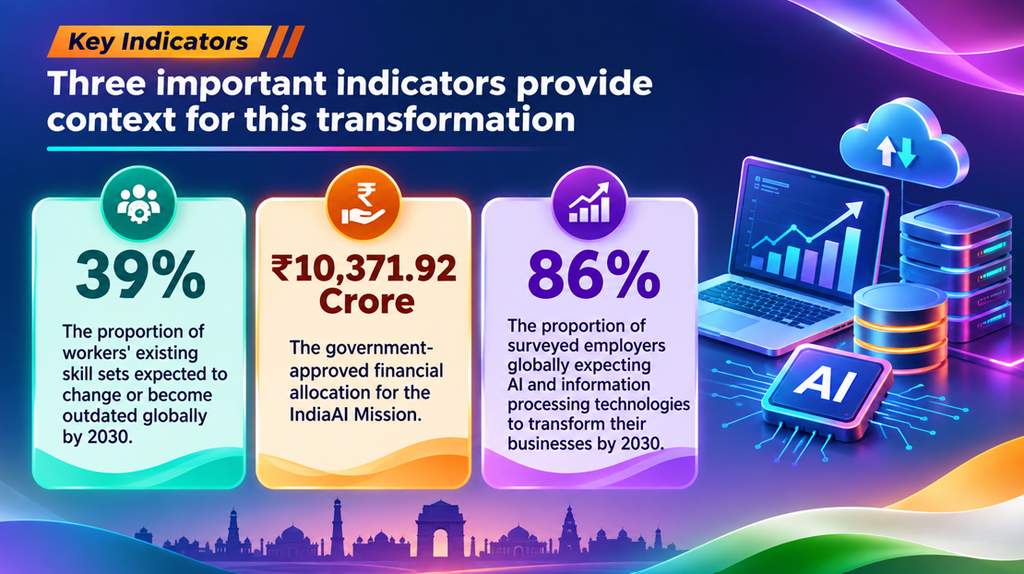
Although these indicators do not directly measure Indian data engineering vacancies, they highlight the broader technological transformation supporting the profession.
In 2027, employers are likely to prioritise professionals who can design scalable data platforms, optimise infrastructure costs, maintain data quality and support AI-driven business applications.
The demand outlook remains positive, but recruitment is expected to become increasingly skill-driven and selective.
2. Key Factors Driving Data Engineering Demand in 2027
Expansion of Global Capability Centres (GCCs)
India is gradually transitioning from a technology outsourcing destination into a global engineering and innovation hub.
Multinational organisations are establishing Global Capability Centres to manage enterprise technology platforms, develop digital products and implement advanced analytics solutions.
These centres create opportunities for data engineers with expertise in cloud architecture, distributed computing, data governance and enterprise-scale data processing.
Artificial Intelligence and Generative AI Adoption
Generative AI applications require sophisticated data infrastructure for document ingestion, knowledge retrieval, embedding generation, model training and continuous evaluation.
The IndiaAI Mission represents a significant government commitment towards strengthening the country’s AI ecosystem through computing infrastructure, datasets, innovation and skill development.
As enterprises adopt AI-powered applications, data engineers will increasingly work with structured, semi-structured and unstructured information.
Cloud Migration and Digital Transformation
Organisations are increasingly complementing traditional on-premises data warehouses with cloud-native platforms.
These transformations require engineers capable of migrating legacy systems, integrating multiple data sources, optimising computing costs and developing scalable architectures.
Opportunities will extend beyond developing new platforms to modernising existing enterprise infrastructure.
3. Top Data Engineer Skills 2027: Technologies You Must Learn
The modern data engineer must combine programming, database engineering, cloud computing and architectural knowledge.
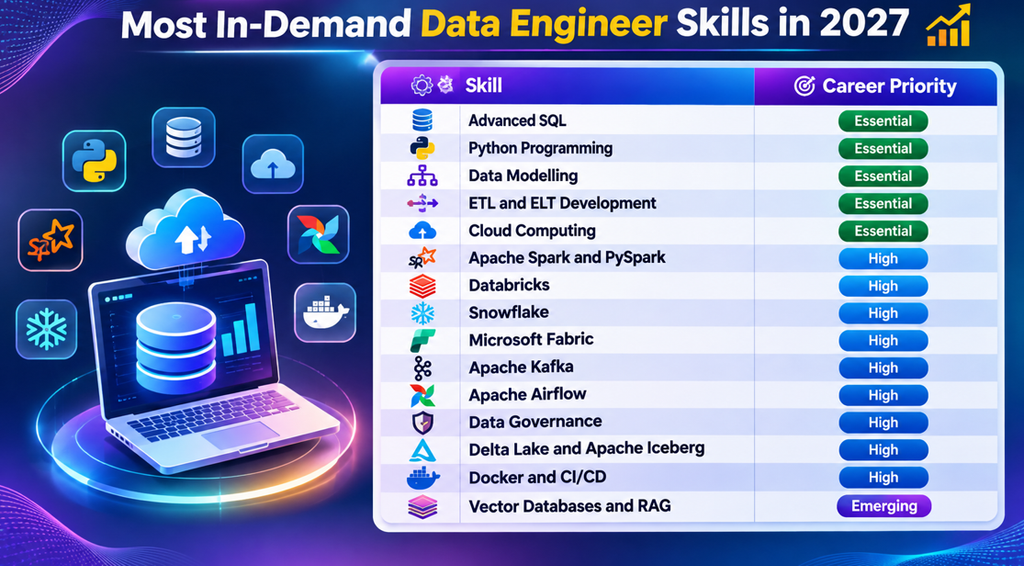
The following skill priorities represent a qualitative assessment of their relevance to modern data engineering rather than measured hiring percentages.
Advanced SQL and Database Engineering
Despite the emergence of AI-assisted coding, SQL remains the foundation of data engineering.
Professionals should develop expertise in complex joins, window functions, common table expressions, indexing, execution plans, partition pruning and query optimisation.
Writing a functional query is no longer sufficient. Engineers must understand execution efficiency, resource consumption and scalability when processing millions or billions of records.
Python and Software Engineering
Python continues to be essential for data ingestion, transformation, automation and integration.
Beyond basic scripting, engineers should understand object-oriented programming, API integration, exception handling, unit testing, logging and reusable package development.
The distinction between a script developer and a production-ready data engineer increasingly lies in software engineering discipline.
Cloud Computing
Mastering at least one major cloud ecosystem should be a career priority.
| Cloud Platform | Important Technologies |
|---|---|
| Microsoft Azure | Azure Data Factory, ADLS, Synapse, Microsoft Fabric |
| Amazon Web Services | S3, Glue, Redshift, EMR |
| Google Cloud | BigQuery, Dataflow, Pub/Sub, Dataproc |
| Databricks | PySpark, Delta Lake, Unity Catalog |
| Snowflake | Snowpark, Streams, Tasks, Dynamic Tables |
Rather than learning every platform simultaneously, engineers should develop deep expertise in one ecosystem and understand transferable architectural concepts.
Apache Spark and Distributed Computing
Apache Spark remains highly relevant for large-scale data transformation and distributed processing.
Engineers should understand PySpark, partitioning, shuffle operations, broadcast joins, adaptive query execution, data skew and memory management.
Understanding why a distributed workload performs poorly is significantly more valuable than simply memorising Spark syntax.
Modern Data Lakehouse Architecture
Data lakehouse architecture combines capabilities associated with data lakes and analytical warehouses.
Technologies such as Delta Lake, Apache Iceberg, Apache Hudi and Apache Parquet support important aspects of modern data management.
Engineers should understand schema evolution, transactional consistency, incremental processing, data versioning and table maintenance.
Real-Time Streaming and Workflow Orchestration
Business applications such as fraud detection, recommendation systems and operational analytics require timely data processing.
Apache Kafka, Apache Flink and Spark Structured Streaming provide relevant real-time processing capabilities.
Meanwhile, Apache Airflow supports workflow orchestration, dependency management, scheduling and failure recovery.
Understanding event-driven architecture, idempotency, checkpointing and fault tolerance will help distinguish experienced engineers from conventional ETL developers.
4. Modern Data Engineering Architecture
The data engineer of 2027 must understand how architectural components interact rather than treating every technology as an isolated skill.
A typical modern data engineering platform consists of the following layers:
- Data Sources: Relational databases, APIs, enterprise applications, IoT devices and streaming events.
- Data Ingestion: Batch pipelines, Apache Kafka and Change Data Capture (CDC).
- Bronze Layer: Raw data storage containing original source records.
- Silver Layer: Cleaned, validated, standardised and transformed data.
- Gold Layer: Business-ready datasets, analytical models and aggregated metrics.
- Consumption Layer: Business intelligence dashboards, machine learning models, AI applications and data APIs.
Data governance, security, orchestration and observability operate across these architectural layers.
This medallion-style architecture is one approach to building scalable and maintainable enterprise data platforms.
5. Data Governance, Privacy and Security Skills
Generative AI is likely to transform data engineering, but complete replacement of the profession is unlikely in the near term.
AI-assisted development can accelerate several routine activities, including SQL generation, documentation, code scaffolding, basic transformations and preliminary debugging.
However, designing enterprise architectures, resolving ambiguous business requirements, maintaining data integrity and governing sensitive information require broader engineering judgement.
An emerging specialisation is AI-ready data engineering, which combines traditional engineering with capabilities such as:
- Retrieval-Augmented Generation (RAG) pipelines.
- Vector databases and embedding generation.
- Unstructured data ingestion.
- Machine learning data preparation.
- AI data quality and lineage.
- Automated pipeline monitoring.
- Knowledge retrieval infrastructure.
Engineers who effectively integrate AI into their workflows may become more productive, while professionals dependent exclusively on repetitive development tasks could face greater competitive pressure.
AI is not eliminating the need for reliable data infrastructure. It is changing how that infrastructure is developed and maintained.
6. Data Governance, Privacy and Security Skills
India’s Digital Personal Data Protection Act, 2023, establishes a legal framework for processing digital personal data.
As applicable regulatory requirements take effect, data engineers must increasingly account for privacy and security throughout the data lifecycle.
Important competencies include sensitive-data classification, data masking, encryption, role-based access control, audit logging, retention policies and data lineage.
Data quality checks should detect missing records, duplicate information and unexpected schema changes. Monitoring data freshness and pipeline failures also helps organisations maintain confidence in analytical outputs.
Data governance should no longer be treated as an administrative responsibility separate from engineering. It must become an architectural consideration from the beginning.
7. Data Engineer Skills 2027: Six-Month Learning Roadmap
Data engineering opportunities are not restricted to conventional IT services companies. Almost every data-intensive industry requires reliable information infrastructure.
| Industry | Data Engineering Applications |
|---|---|
| Banking and Fintech | Fraud detection, risk analytics and transactions |
| Retail and E-commerce | Recommendations and customer analytics |
| Healthcare | Clinical data integration and predictive analytics |
| Manufacturing | IoT pipelines and predictive maintenance |
| Telecommunications | Network analytics and streaming data |
| IT Services and GCCs | Cloud migration and enterprise data platforms |
| Logistics | Supply chain analytics and real-time tracking |
| AI Startups | RAG pipelines and training datasets |
| Insurance | Claims processing and risk modelling |
Industry-specific knowledge can provide a significant competitive advantage.
For example, an engineer who understands financial transactions and regulatory reporting can contribute more effectively to a banking institution than someone possessing only generic technology skills.
8. Data Engineer Salary and Career Outlook in 2027
Data engineering compensation varies considerably depending on experience, employer category, location, technical expertise and architectural responsibilities.
Professionals working in product companies, specialised technology teams and Global Capability Centres may encounter different compensation structures from those working in conventional service-delivery environments.
Entry-Level Professionals
Junior data engineers typically focus on SQL, Python, ETL development, data validation, pipeline monitoring and database operations.
Mid-Level Professionals
Experienced data engineers are expected to manage cloud infrastructure, distributed processing, workflow orchestration, performance optimisation and production pipeline ownership.
Senior-Level Professionals
Senior data engineers, technical leads and data architects focus on enterprise architecture, platform modernisation, infrastructure cost optimisation, governance and technical leadership.
A reliable national salary forecast for 2027 cannot yet be established from the available evidence. Candidates should evaluate current advertised compensation alongside experience requirements, fixed pay, variable pay and other benefits.

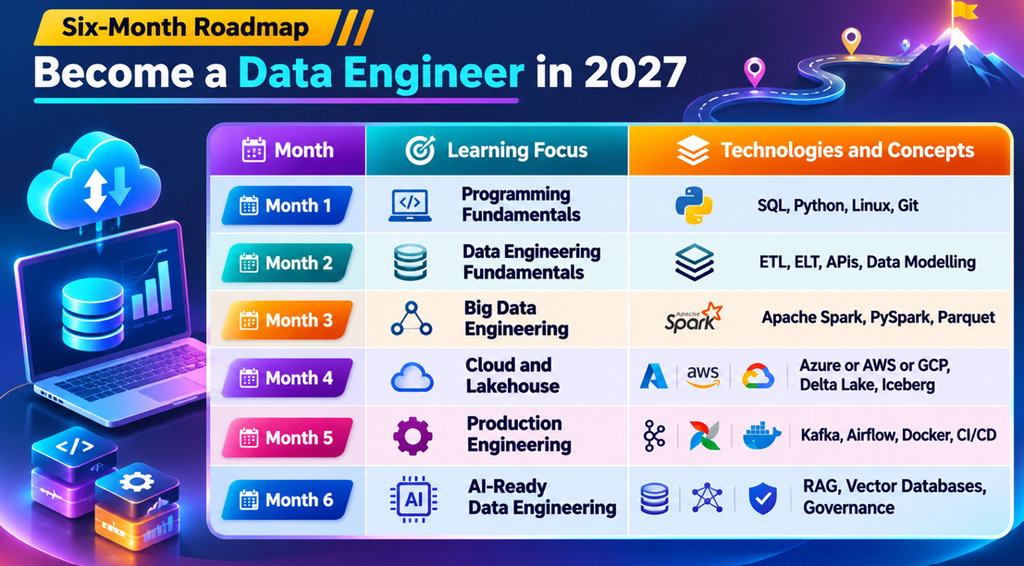
9. Data Engineer Skills 2027: Six-Month Learning Roadmap
A structured learning strategy is more effective than attempting to master every available technology simultaneously.
The most important Data Engineer Skills 2027 include advanced SQL, Python programming, data modelling, cloud computing, Apache Spark and workflow orchestration. In the Indian job market, professionals with expertise in Databricks, Snowflake, Microsoft Fabric, Azure, AWS and Google Cloud may benefit from opportunities associated with enterprise digital transformation.
Emerging capabilities such as lakehouse architecture, real-time data streaming, data governance, vector databases and Retrieval-Augmented Generation (RAG) are also becoming increasingly relevant. Developing a combination of foundational and specialised skills can help professionals remain competitive in an evolving technology employment landscape.
Aspiring engineers should demonstrate these capabilities through practical projects using publicly available datasets.
A well-documented production-style project demonstrating ingestion, transformation, testing, orchestration and monitoring can provide stronger evidence of competency than a collection of basic tutorials.
Certifications can complement practical experience, but they should not replace hands-on engineering knowledge.
10. Future of Data Engineering in the Indian Market
The available evidence supports a positive but selective outlook for data engineering in 2027.
Cloud-native transformation, enterprise AI adoption, GCC expansion and increasing governance requirements are likely to sustain demand for specialised professionals.
However, entry-level candidates may encounter greater competition, while experienced engineers capable of designing and maintaining complete platforms could benefit from stronger opportunities.
| Specialisation | Expected 2027 Relevance |
|---|---|
| Cloud Data Engineering | Very High |
| AI-Ready Data Engineering | Very High |
| Data Platform Engineering | High |
| Lakehouse Architecture | High |
| Real-Time Data Engineering | High |
| Data Governance Engineering | High |
| Traditional Repetitive ETL | Under Automation Pressure |
These assessments represent qualitative career projections rather than confirmed 2027 employment statistics.
Frequently Asked Questions
Is data engineering a good career in India in 2027?
Yes. The broader growth of artificial intelligence, cloud computing and big data supports a positive career outlook. Individual employment opportunities will depend on technical competency, experience and market conditions.
Can a fresher become a data engineer?
Yes. Freshers should develop strong SQL and Python fundamentals, understand database systems and demonstrate their capabilities through practical end-to-end data engineering projects.
Is Python enough to become a data engineer?
No. Python is an important programming language, but data engineers also require SQL, data modelling, database engineering, cloud computing and pipeline development skills.
Is Databricks worth learning in 2027?
Databricks is worth considering for professionals interested in distributed computing, lakehouse architecture, PySpark and enterprise-scale data processing. Its relevance depends on the technology requirements of target employers.
Will AI reduce data engineering jobs?
AI may reduce the need for certain repetitive development activities. However, enterprise architecture, data governance, infrastructure reliability and AI-ready data pipelines are likely to remain important engineering responsibilities.
Conclusion: Preparing for a Data Engineering Career in 2027
Mastering the right Data Engineer Skills 2027 can help technology professionals prepare for India’s evolving digital economy. The growing adoption of artificial intelligence, cloud computing, big data analytics and modern data platforms is expected to create opportunities for skilled data engineers across multiple industries.
Professionals should prioritise advanced SQL, Python, Apache Spark, cloud computing, data modelling and modern data architecture. Emerging technologies such as Microsoft Fabric, Databricks, Snowflake, vector databases and AI-ready data pipelines can further strengthen their technical capabilities.
However, learning technologies alone is not sufficient. Employers increasingly value practical experience, architectural thinking, problem-solving abilities, data governance and production engineering expertise.
For fresh graduates and experienced IT professionals, developing a structured learning roadmap and building real-world projects can provide a strong foundation for long-term career growth.
The future of data engineering in India will be shaped by professionals who continuously learn, adapt to emerging technologies and understand how data creates measurable business value.
In the AI-driven economy, data engineers will not merely move data between systems. They will build the foundations upon which enterprise intelligence operates.
